
Equity Release Solicitors
Unlock the value in your home – with expert local legal guidance every step of the way.



Equity Release Solicitors in Crowborough, Burgess Hill, Haywards Heath and beyond
Equity release can be a practical way to access money tied up in your property. But it’s a major financial decision – one that requires clear, independent financial and legal advice to ensure your best interests are protected.
Our solicitors specialise in advising homeowners across the South East on the legal implications of an equity release mortgage.
We are proud to be members of The Equity Release Council which means we pledge to adhere to the highest standards of client care.
What is Equity Release?
Equity Release, also known as a lifetime mortgage, allows you to release tax-free cash from the value of your home while continuing to live there. It is typically available to homeowners aged 55 and over and can help with:
Supplementing retirement income
Funding care or medical needs
Helping children or grandchildren onto the property ladder
Paying off existing debts
Enjoying later-life plans such as travel or home improvements


What does it mean?
You borrow against the value of your home, and the loan is repaid when the property is sold, usually after death or entering long-term care.
Why Do I Need a Solicitor for Equity Release?
Lending requirements stipulate that you need to receive independent legal advice before committing to any equity release scheme. This ensures:
You fully understand the long-term implications
You’re aware of how it may affect your estate, benefits, or tax position
You are not being pressured into the decision


What is the equity release process?
Our experienced equity release solicitors will:
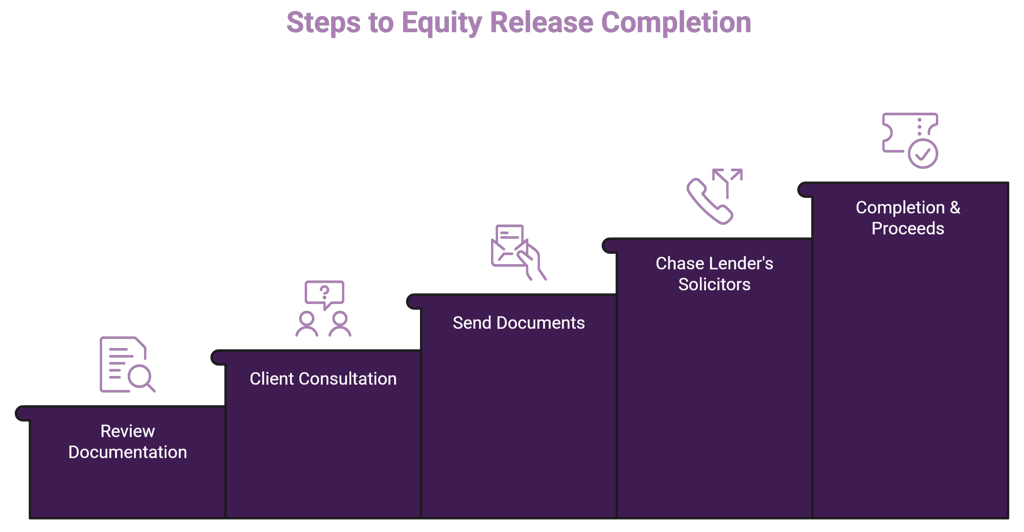
Review all lender documentation and identify any potential issues which could delay completion
Provide a consultation to explain the legal process, what to expect and obtain all required information and signatures
Liaise with your lender's solicitors and financial adviser
We can offer fixed fees for most equity release matters and can work swiftly to meet your lender’s timelines.
Why choose Claire Nash Solicitors for equity release?
Our friendly team are experts in equity release and will guide you through the process.


Our experienced equity release
solicitors and professionals
Claire Nash
Emma Santos


Equity release solicitors in Crowborough & Haywards Heath
Get in touch with our friendly equity release solicitors and discuss how you can unlock the value that is tied up in your home.
Call us to arrange an appointment:
Crowborough - 01892 731082
Burgess Hill - 01444 417944
Frequently asked questions
What is the difference between a lifetime mortgage and a home reversion plan?
These are the two main types of equity release products available in the UK. A lifetime mortgage is a loan secured against your home that does not need to be repaid until you die or move into long-term care. Interest accrues on the loan over time, either rolled up or paid monthly. You retain ownership of your home throughout. A home reversion plan involves selling a portion or all of your home to a provider in exchange for a lump sum or regular payments. You continue to live in the property rent-free, but you no longer own all of it and will not benefit fully from any increase in its value. The vast majority of equity release taken out today is in the form of a lifetime mortgage. As solicitors, we advise on the legal aspects of equity release rather than which product is right for you financially, for which you should consult a qualified financial adviser.
Do I need a solicitor for equity release, and why?
Yes. Equity release providers require you to take independent legal advice before completing the process. This is a regulatory requirement and a consumer protection measure, not simply a formality. Your solicitor's role is to ensure you fully understand the legal implications of what you are signing, including what happens to your property during your lifetime and after your death, how the plan affects your estate and any inheritance you intend to leave, and what your rights and obligations are under the agreement. At Claire Nash Solicitors, we are a member of the Equity Release Council and have considerable experience advising clients through this process. We will take the time to ensure you are fully informed before proceeding.
Does equity release affect my entitlement to means-tested benefits?
Yes, it can. Equity release releases capital from your property, which increases the liquid assets you hold. If those assets take you above the thresholds for means-tested benefits such as pension credit, council tax reduction or help with care costs, your entitlement may be reduced or lost entirely. The impact depends on how you use the money released. If funds are spent immediately, the effect may be short-lived. If they are retained as savings or investments, the impact could be ongoing. Before proceeding with equity release, it is important to take independent financial advice and to check with the relevant benefit authorities how a release of equity would affect your specific position.
Can I still leave money to my children if I take out equity release?
Yes, though the amount left to inherit will be reduced by the amount owed on the equity release plan, including any interest that has accumulated. Many modern lifetime mortgage products offer an inheritance protection guarantee, which ring-fences a percentage of the property's value to be preserved for your beneficiaries regardless of how long you live. It is also worth updating your Will when you take out equity release to ensure it reflects your current wishes and accurately accounts for the changed structure of your estate. We recommend discussing the inheritance implications with your financial adviser before proceeding and reviewing your Will as part of the process.
What happens to the equity release plan when I die or move into care?
A lifetime mortgage becomes repayable when the last surviving borrower dies or moves into long-term care permanently. The property is typically sold, and the proceeds are used to repay the loan, including any rolled-up interest. Any remaining equity passes to your estate and ultimately to your beneficiaries. Most mortgage plans regulated by the Equity Release Council are required to offer a no negative equity guarantee, which means you or your estate will never owe more than the property is worth, even if house prices fall. If you move into care, the timeline for selling the property will depend on whether anyone else is living in it at the time.
Is equity release safe, and what protections are in place?
Equity release products regulated by the Equity Release Council come with a set of consumer protections. These usually include the no negative equity guarantee, meaning you will never owe more than your home is worth; the right to remain in your home for life or until you move into permanent care; and, for lifetime mortgages, the right to make voluntary partial repayments without penalty, subject to product terms. As a member of the Equity Release Council, Claire Nash Solicitors acts as your independent legal adviser, ensuring you fully understand the implications of the plan before it proceeds. Our role is to protect your interests throughout the process.
Can I repay my equity release mortgage early, and are there penalties?
This depends on the specific product you have taken out. Many lifetime mortgages allow voluntary partial repayments without penalty up to a certain amount per year, typically 10% of the outstanding balance. Full early repayment is possible but often attracts an early repayment charge, which can be significant. Some products offer more flexible terms. It is important to understand the repayment terms before committing to any equity release product, which is another reason why independent financial advice is essential.
How much equity can I release from my home?
The amount you can release depends on several factors, including your age, the value of your property and the specific product chosen. Generally, the older you are and the more valuable your property, the higher the percentage you can release. Most lifetime mortgages allow release of between 20% and 60% of the property's value, though this varies by provider and product. There may also be restrictions if your property is of non-standard construction or has certain characteristics that affect its saleability. Your financial adviser will calculate what is available to you based on your individual circumstances and will be able to compare products from across the market.
Website Privacy Policy
Sign up for our newsletter coming soon!
Website Terms & Conditions
© 2025. All rights reserved.
Site design by Betterment Agency
Claire Nash Solicitors is the trading name of Claire Nash Solicitors LTD Co. No. 10958514, VAT Number 285 152495 Claire Nash Solicitors is authorised and regulated by the Solicitors Regulation Authority. SRA number 643261