
Divorce
Compassionate, expert legal advice when you need it most.



Divorce Solicitors in Crowborough, Burgess Hill, Haywards Heath and beyond
When relationships break down, we know it can be emotionally and financially challenging. Our experienced divorce solicitors are here to provide clear legal guidance, protect your interests, and help you move forward with confidence.
We support clients across East Sussex and West Sussex with all aspects of divorce from our main offices in Crowborough.


Getting divorced in Sussex
To divorce in England and Wales, you must have been married for at least one year, and the marriage must be legally recognised in the UK.
Under the no-fault divorce law introduced in 2022, you no longer need to assign blame or prove wrongdoing to obtain a divorce. Either party — or both jointly — can simply state that the marriage has irretrievably broken down.


Why do I need a divorce solicitor?
Divorce is an extremely difficult and stressful time for individuals and other family members. We recognise that and are happy to offer an initial consultation to enable you to discuss the process and the issues that concern you the most with our expert professionals. We understand that it is important to get a sense of direction before deciding whether any further professional input is necessary, and so our initial consultations are on a no obligation basis.
You might be concerned about the implications of a family breakup on the matrimonial home and your finances
Our divorce solicitors provide expert, friendly advice if you are considering divorce or if you have received a divorce petition from your spouse or civil partner, and our experienced team are available to discuss the implications of this with you.


How we can help
Our specialist divorce law solicitors can support you through every stage of the divorce process, including:
Filing for divorce (sole or joint applications)
Responding to a divorce application
Financial settlements and division of assets
Pension and property arrangement
Spousal maintenance and child maintenance
Updating your Will after divorce
We take a practical, sensitive approach and aim to resolve matters amicably wherever possible.


What is the divorce process?
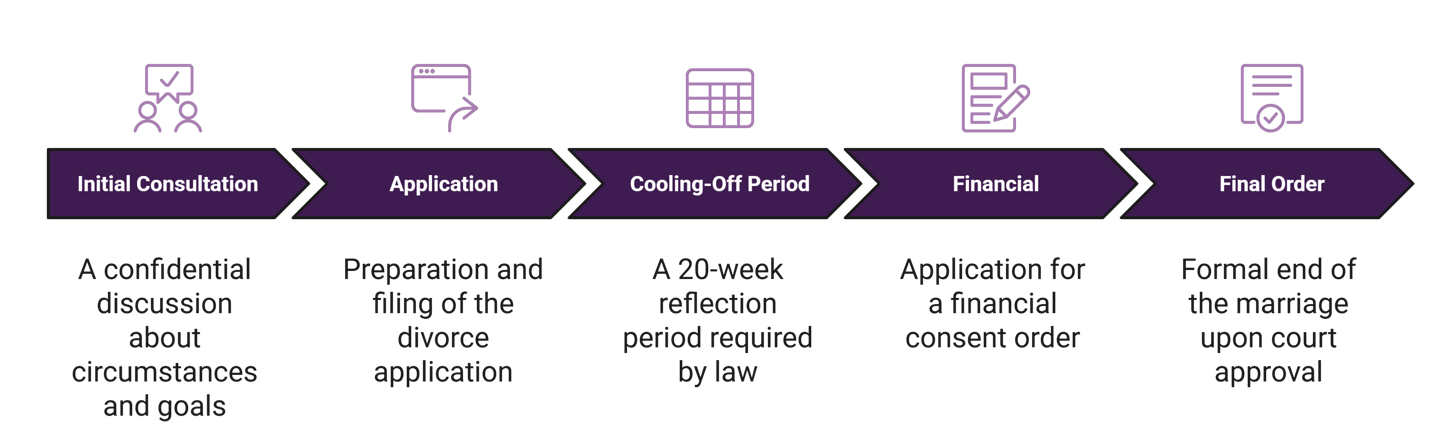
This will depend on whether matters are agreed between you and your spouse, but in general terms the process is as follows:
Initial Consultation – A confidential discussion about your circumstances, goals, and next steps.
Application – We prepare and file your divorce application with the court.
Cooling-Off Period – The law requires a 20-week reflection period before the conditional order can be granted.
Financial – Once you have a conditional order, we will be in a position to apply for a financial consent order.
Final Order – Once approved by the court, this formally ends the marriage.
The entire process typically takes around 12 months, but can vary depending on complexity and whether disputes arise.

Why choose Claire Nash Divorce Solicitors?
We understand that every family is different and that every situation is different. Whether your divorce is amicable or contested, straightforward or complex, we are here to protect your future and guide you through the divorce process
We will never pass judgement and will handle your matter with compassion and discretion.


Our experienced divorce team
Claire Nash
Neuma Domingos




Emma Santos
Frequently asked questions
How long does divorce take under the no-fault divorce law introduced in 2022?
The no-fault divorce process introduced under the Divorce, Dissolution and Separation Act 2020, which came into force in April 2022, established a minimum timeframe of approximately six months from the point of application to the granting of a final order. The process involves two stages: a conditional order and a final order. There is a mandatory reflection period of twenty weeks between the application and the conditional order, and then a further six-week minimum before the final order can be applied for. This means the legal divorce itself takes at least six months in straightforward cases, but it may take longer if financial matters are not resolved at the same time.t.
How much does a divorce cost in England and Wales?
The court fee for filing a divorce application is currently £612 Beyond this, legal costs vary considerably depending on whether the divorce is contested or straightforward, whether financial matters are agreed or need to be resolved through court, and the level of solicitor involvement required. An uncontested divorce where finances are agreed can be handled for a relatively modest legal fee. A contested financial settlement that requires court proceedings can cost considerably more. We are transparent about our fees and will provide a clear estimate at the outset based on your circumstances.
What is a financial consent order, and do I need one?
A financial consent order is a legally binding document that records the financial agreement reached between divorcing parties and is approved by the court. Without a consent order, financial claims between former spouses remain open indefinitely, even after the divorce is finalised. This means that years after the divorce, either party could potentially make a financial claim against the other, for example, if one party's circumstances change significantly. A consent order closes those claims permanently. It covers the division of property, pensions, savings, investments and any maintenance payments. We strongly recommend obtaining a consent order as part of any divorce, even where the financial settlement appears straightforward and amicable.
Can I divorce if my spouse refuses to engage with the process?
Yes. Under the current no-fault divorce process, it is no longer possible for one spouse to defend a divorce. If you apply for a divorce, either a sole or joint application, the divorce will proceed regardless of whether your spouse cooperates, provided the procedural requirements are met. Your spouse will be served with the divorce application and will have an opportunity to respond, but they cannot prevent the divorce from happening. However, a spouse who refuses to engage can still make the financial aspects of the divorce more complicated and potentially more costly if matters need to be resolved through court proceedings rather than by agreement. We can advise you on the best approach for your specific situation.
What happens to the family home during a divorce?
The family home is often the most significant asset in a divorce, and there are several possible outcomes depending on the circumstances. The most common options are that one party buys out the other's share and remains in the property, the property is sold and the proceeds divided, or the property is transferred to one party temporarily, often to provide stability for children, with a deferred sale at a later date. Which outcome is most appropriate depends on factors including each party's financial position, the needs of any children, mortgage affordability and the overall financial settlement. Any transfer or sale of the property requires conveyancing work, which we can handle as part of the overall divorce process.
How is a pension divided in a divorce settlement?
Pensions are often the largest asset in a divorce after the family home, but they are frequently overlooked or undervalued. There are three main approaches to dividing a pension on divorce. Pension sharing involves splitting the pension fund at the point of divorce, giving each party their own separate pension. Pension offsetting involves one party keeping the pension while the other receives a greater share of other assets, such as the family home, to compensate. Pension earmarking involves a portion of one party's pension being paid to the other when it is eventually drawn, though this approach is relatively uncommon. A pension actuary or independent financial adviser can help value pensions accurately, and we work with these specialists as part of the financial settlement process.
What is the difference between separation and divorce?
Separation means living apart from your spouse, either informally or under a formal legal separation agreement. It does not end the marriage. Divorce ends the marriage legally and allows both parties to remarry. Some couples choose to separate rather than divorce for religious reasons, to preserve financial benefits that are tied to marital status, or simply because they are not yet ready to proceed with a divorce. A deed of separation can record the terms of a separation and is a legally binding contract, but it is not as comprehensive or final as a divorce settlement. If you are considering separation rather than divorce, we can advise you on what a separation agreement can and cannot achieve.
Do I need a solicitor for divorce or can I do it myself?
The online divorce process has become more accessible since the reforms of 2022, and it is possible to apply for a divorce without a solicitor. However, the legal process of the divorce itself is only part of what needs to be resolved. Financial matters, including the division of property, pensions and savings, require careful consideration and ideally a legally binding financial consent order. Getting the financial settlement wrong, or failing to obtain a consent order, can have very long-term consequences. A solicitor can also help where there are disagreements, children's arrangements to consider, or where one party has significantly greater resources or legal knowledge than the other. We offer a range of services depending on how much assistance you need.
Website Privacy Policy
Sign up for our newsletter coming soon!
Website Terms & Conditions
© 2025. All rights reserved.
Site design by Betterment Agency
Claire Nash Solicitors is the trading name of Claire Nash Solicitors LTD Co. No. 10958514, VAT Number 285 152495 Claire Nash Solicitors is authorised and regulated by the Solicitors Regulation Authority. SRA number 643261